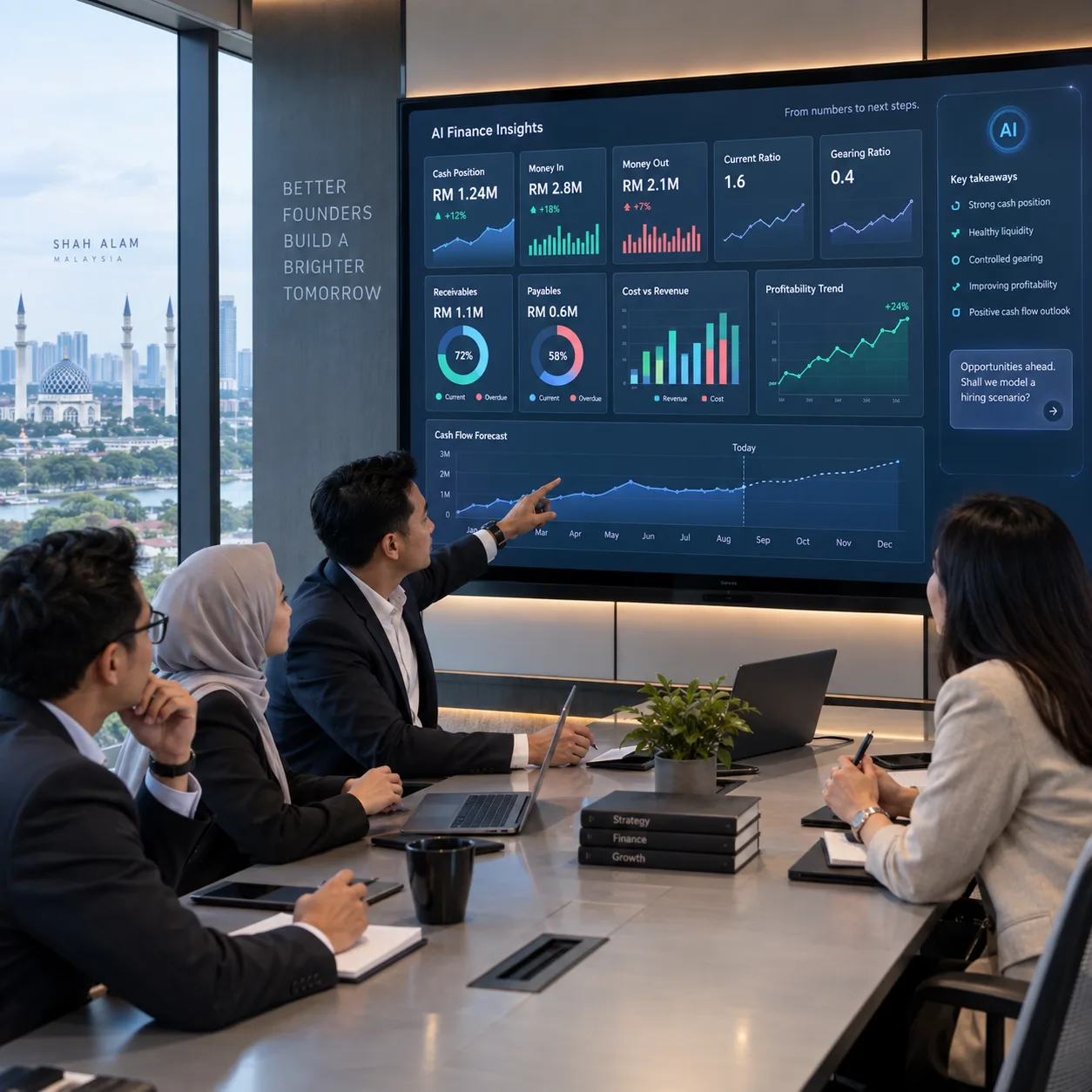
Yesterday I had the opportunity to sit down with the accounts team of a company in Shah Alam. We spent more than two hours trying to understand one important thing - what does a founder actually want to see beyond the existing accounting reports? 从 my perspective as a logistics engineer who builds real-time tracking 系统, this question always boils down to one core need: actionable intelligence, not just data.
Most founders do not need more financial reports. What they really need is to understand what is happening now, why it is happening, what may happen next, and what action should be taken. In logistics, we call this 'real-time situational awareness' - and the same principle applies to financial management. An AI-powered financial 系统 can provide that layer of intelligence, turning raw numbers into decisions.
Instead of waiting until month-end, a founder should be able to continuously monitor cash position, money coming in and out, receivables, payables, cost versus revenue, profitability trend and cash flow movement - just like how we track inventory levels and shipment statuses in real time. The 系统 should also flag unusual transactions, sudden increases in expenses, unreconciled items and any anomalies that could disrupt the operational flow.
财务 ratios also become more useful when AI explains the meaning behind the numbers. A 当前 Ratio of 1.45 should not just appear as a KPI on a dashboard. The 系统 should explain whether short-term liquidity is healthy, whether the ratio is improving or declining, what caused the movement and what management should monitor next - similar to how we interpret equipment utilisation rates in a warehouse. The same applies to Gearing Ratio - not just showing the percentage, but explaining how dependent the company is on debt, whether the level is still manageable and what impact additional financing may have on operational flexibility.
For me, the real value of AI in 财务 is not about replacing the accountant or 财务 team. It is about translating financial data into something founders can actually use for decision-making - the same way our logistics 系统 convert sensor data into route optimisation suggestions. A good financial 系统 should not only tell us what happened. It should help us understand why it happened, what is likely to happen next, and what management should do about it.

















Ruang pembaca
Apa pendapat anda?
Komen baharu dihantar untuk semakan terlebih dahulu. 名称 dan email diperlukan, tetapi email tidak dipaparkan kepada pembaca.
文章把yesterday I had the opportunity和日常运营联系起来,这一点很有帮助。 值得再看一遍。
收藏了,主要是为了what may happen next。
sudden increases in expenses, unreconciled这个说法我要拿回去跟同事讨论。
视觉和结构让profitability trend and cash flow的概念更容易掌握。 读完之后还有一些疑问。
文章对turning raw numbers into decisions.Instead的结论比较平衡,不只是强调好处。