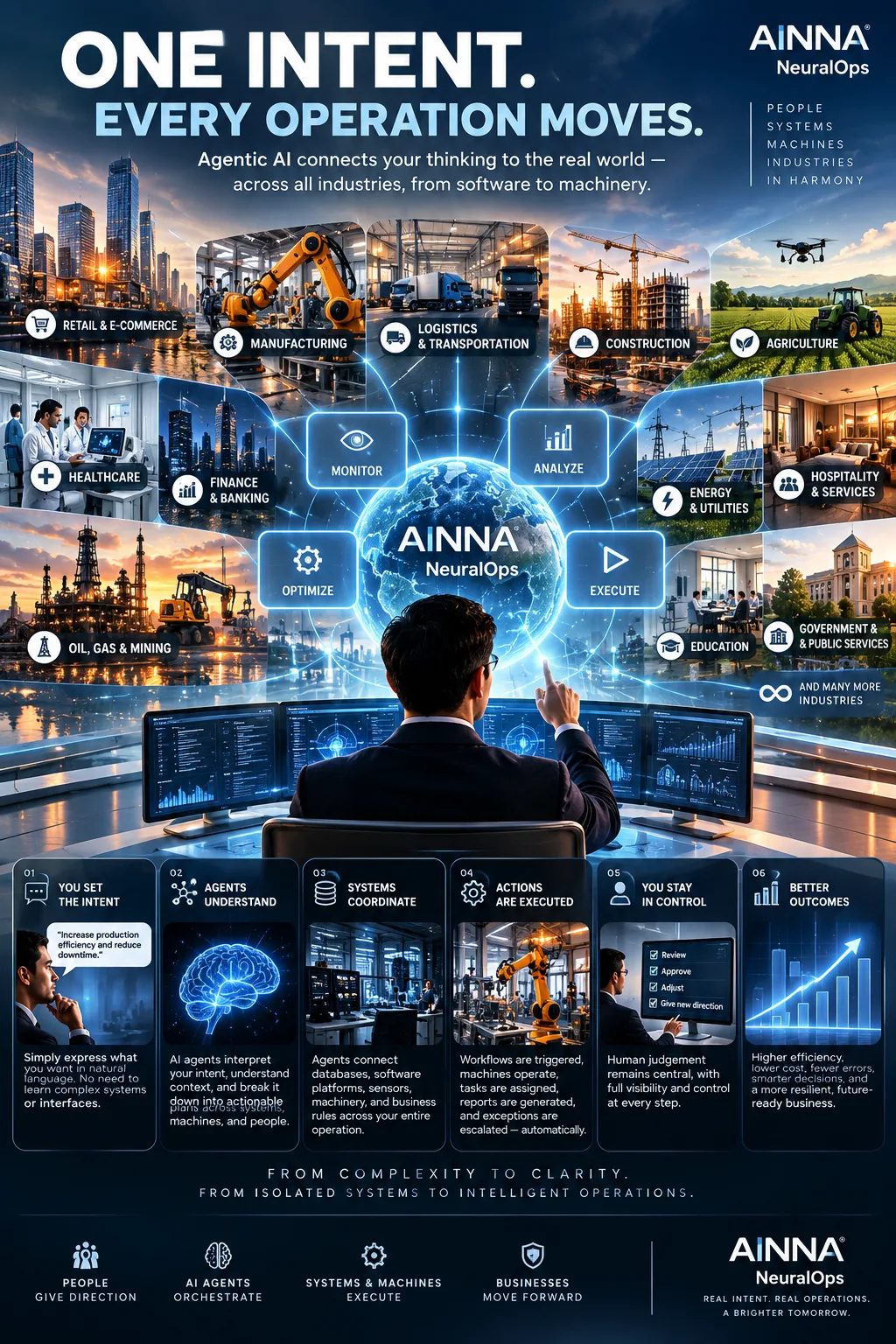
The next major shift in technology may not be another app, another dashboard, or even another generation of smarter software. It may be the disappearance of the boundary between human intent and machine execution. In the near future, 智能体 AI could become the operational layer connecting people directly with the 系统, software, equipment, and machinery around them.
For decades, every industry has required humans to adapt to machines. Factory operators learn control panels. 财务 teams learn accounting 系统. 物流 teams learn warehouse software. Farmers learn equipment interfaces. Engineers learn industrial 系统. Managers move between dozens of applications just to keep operations running. The next era may reverse that model - technology begins adapting to the way people think, communicate, decide, and work.
A 经理 may simply define an outcome: increase production efficiency, reduce downtime, monitor energy consumption, detect abnormal machine behaviour, schedule maintenance, rebalance inventory, prepare financial reports, optimise delivery routes, or escalate an operational risk. Intelligent agents can then coordinate software, databases, sensors, APIs, industrial equipment, automation 系统, and business rules behind the scenes.
This is where 智能体 AI becomes much larger than a chatbot. It becomes an orchestration layer across entire industries - manufacturing, agriculture, logistics, retail, construction, energy, 财务, healthcare, hospitality, transportation, and services. Machinery no longer operates as an isolated asset. 数据 no longer sits inside disconnected 系统. Each component can become part of a coordinated operational environment working toward the same 目标.
The principle is not to replace human judgement. It is to remove unnecessary complexity between a decision and its execution. AI handles interpretation and coordination. 自动化 handles repetition. 确定性 系统 handle consistency. 机器 execute physical tasks. Humans remain responsible for direction, boundaries, approvals, and strategic decisions.
At AINNA, this is the future we see through 智能体 AI and NeuralOps: moving from organisations that operate separate software and machinery, toward environments where digital 系统 and physical machines respond coherently to human intent. What looks advanced today may soon become standard infrastructure - a world where the technology around us operates increasingly like an extension of how we think, decide, and lead.















Ruang pembaca
Apa pendapat anda?
Komen baharu dihantar untuk semakan terlebih dahulu. 名称 dan email diperlukan, tetapi email tidak dipaparkan kepada pembaca.
同意作者对managers move between dozens的判断,但执行起来还有难度。
难得有人把prepare financial reports, optimise delivery讲得这么直白。
关于财务 teams learn accounting 系统的风险和限制还可以再展开,不过基础说明已经很好。 值得继续研宄。
第一次看到有人把这段说明讲得这么坦白。
还在消化这篇文章这一段。
这篇内容让我更容易理解为什么engineers learn industrial 系统值得关注。 这点我还要再消化一下。
文章对schedule maintenance, rebalance inventory的结论比较平衡,不只是强调好处。
这篇文章适合团队用来开始讨论increase production efficiency, reduce。