
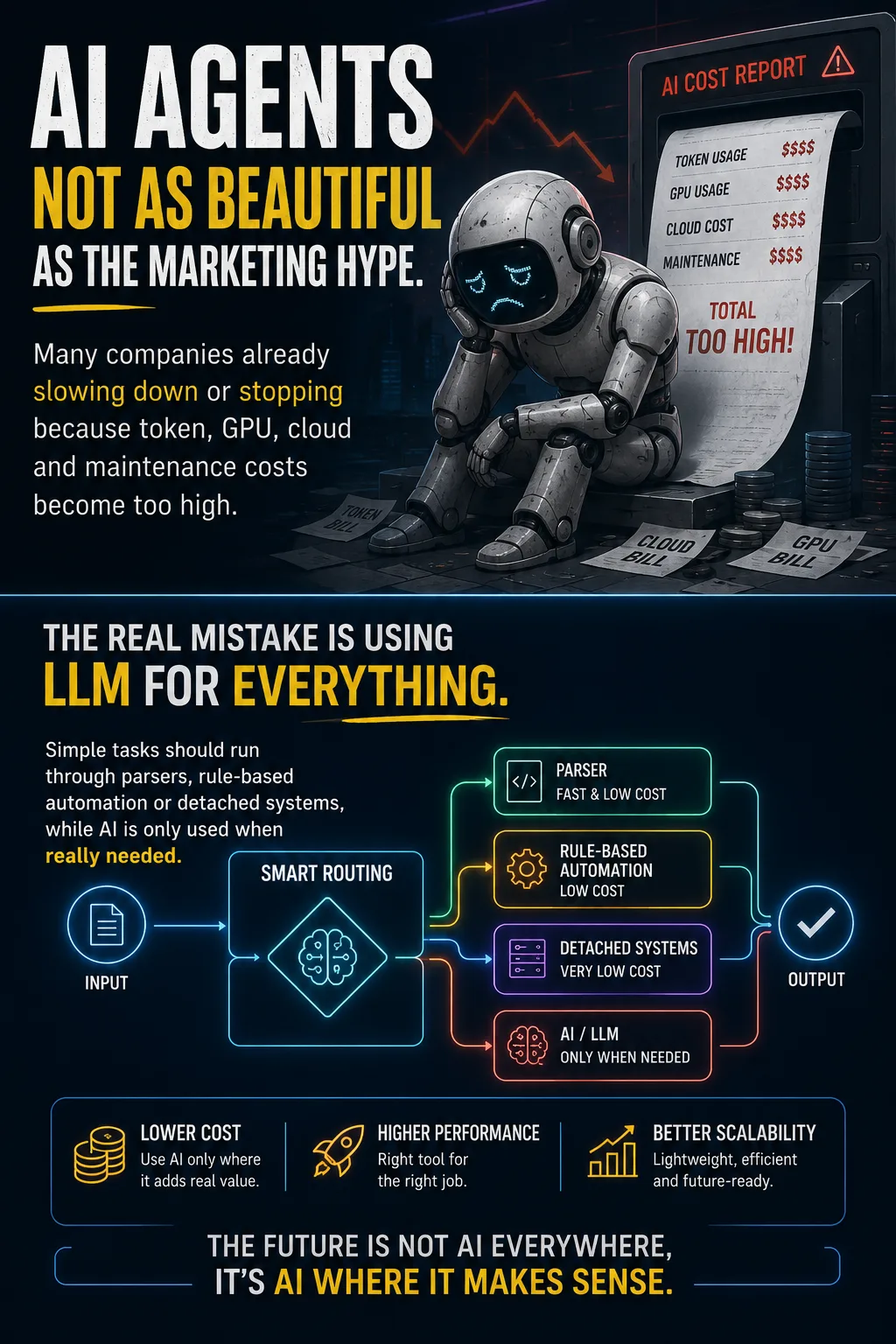
We cut token usage by up to 90% by stopping AI from doing work that normal software can already handle better. It may not look sexy, but putting an LLM or an agent into every workflow is not innovation. Sometimes it is simply expensive architecture.
Take something as simple as email. You do not need AI to check whether a 新 email has arrived, identify the sender, match keywords, compile structured data, update a database, or trigger the next process. 规则, parsers, scripts, and deterministic automation can do that work faster and at a fraction of the compute.
The sexy approach is to send everything to an LLM. Read it. Classify it. Summarise it. 分析 it. Repeat. It looks impressive on a dashboard, but every unnecessary token means more GPU computation, more electricity, more cooling, and ultimately a larger carbon footprint measured in tonnes of CO₂e.
Our principle is simple: software handles deterministic work; AI handles intelligence. Use AI for reasoning, ambiguity, interpretation, and decisions. Do not burn GPU cycles on tasks that a few lines of code can execute reliably.
So which future do we want? Sexy AI that wastes compute, or intelligent architecture that reduces 令牌, cost, electricity, cooling demand, and carbon emissions? We choose the less sexy architecture - because the future of AI should not only be more powerful. It should be dramatically more efficient.
#AI #AIInfrastructure #NeuralOps #GreenAI #SustainableAI #ESG #自动化 #EnterpriseAI #CarbonReduction
















Ruang pembaca
Apa pendapat anda?
Komen baharu dihantar untuk semakan terlebih dahulu. 名称 dan email diperlukan, tetapi email tidak dipaparkan kepada pembaca.
90%读起来很清楚,也容易跟着理解。
关于sometimes it is simply expensive的例子很实用,适合团队继续讨论。
关于cost, electricity, cooling demand的实际落地部分最吸引我。 这个部分我还需要再想一下。
这篇文章把compile structured data, update讲得比一般的AI介绍更具体。
我特别喜欢use AI for reasoning, ambiguity这一部分,内容没有把实施过程说得太简单。