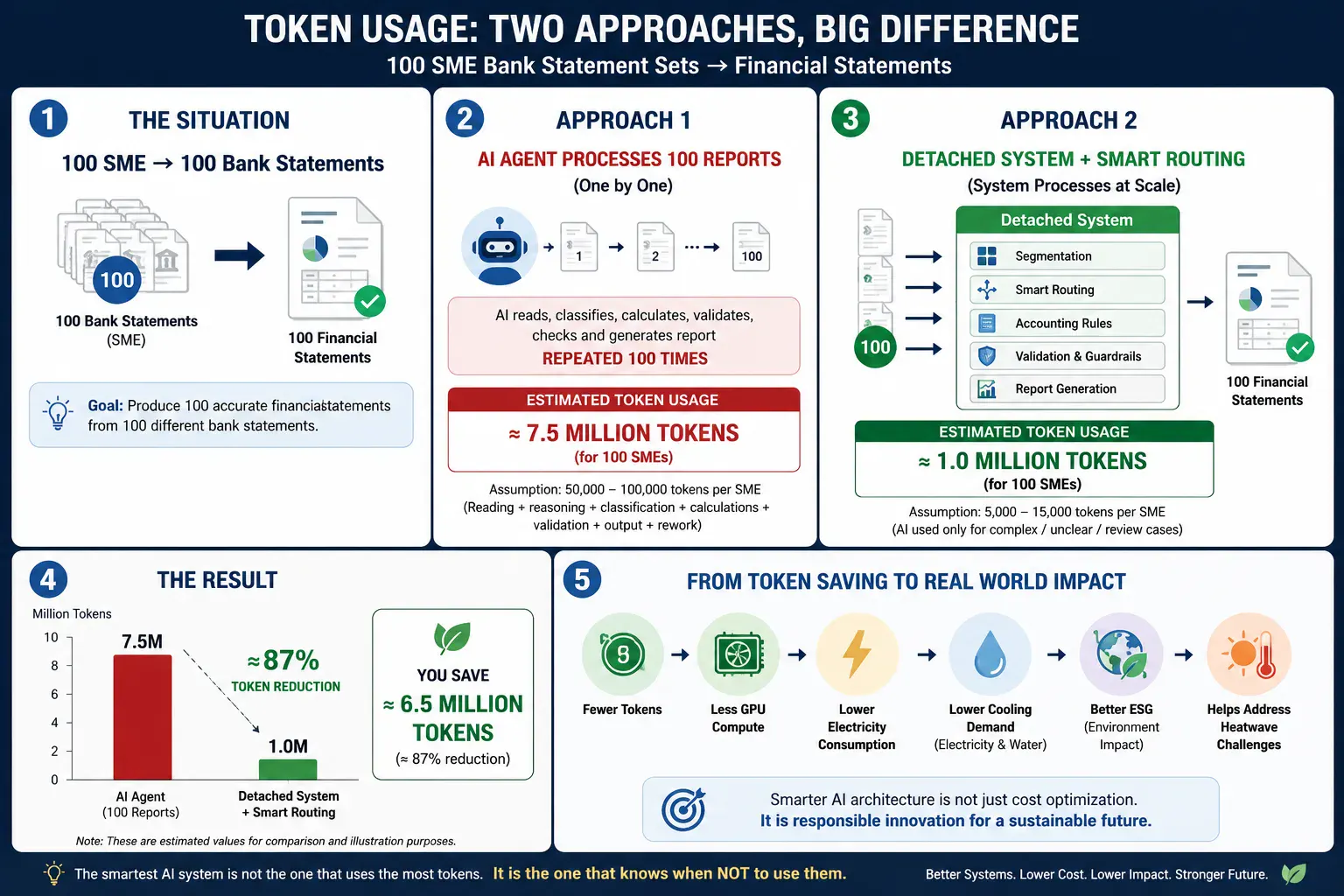
Most people underestimate how complicated SMqE bank statement automation can become.
想象 100 中小企业. Each 中小企业 uploads 100 pages of bank statements. That is not “100 files” only. That is 10,000 pages of financial data, possibly containing thousands of transactions, OCR noise, duplicate entries, internal transfers, bank charges, refunds, cash deposits, platform payouts, loan movements, and unclear descriptions.
If we use the first approach, the AI agent reads and reasons through everything directly. For a heavy 100-page 中小企业 file, a full AI workflow may consume around 200,000 to 500,000 令牌 per 中小企业, including extraction, classification, validation, correction, and report generation. For 100 中小企业, that becomes roughly 20 million to 50 million 令牌.
Using Claude as the premium full-processing model, the cost can grow quickly. If we use a mid-range estimate of 35 million 令牌, split as 80% input and 20% output, that means around 28 million input 令牌 and 7 million output 令牌. At Claude Sonnet intro pricing of $2 input and $10 output per million 令牌, that is about $126. At standard pricing of $3 input and $15 output, it becomes about $189.
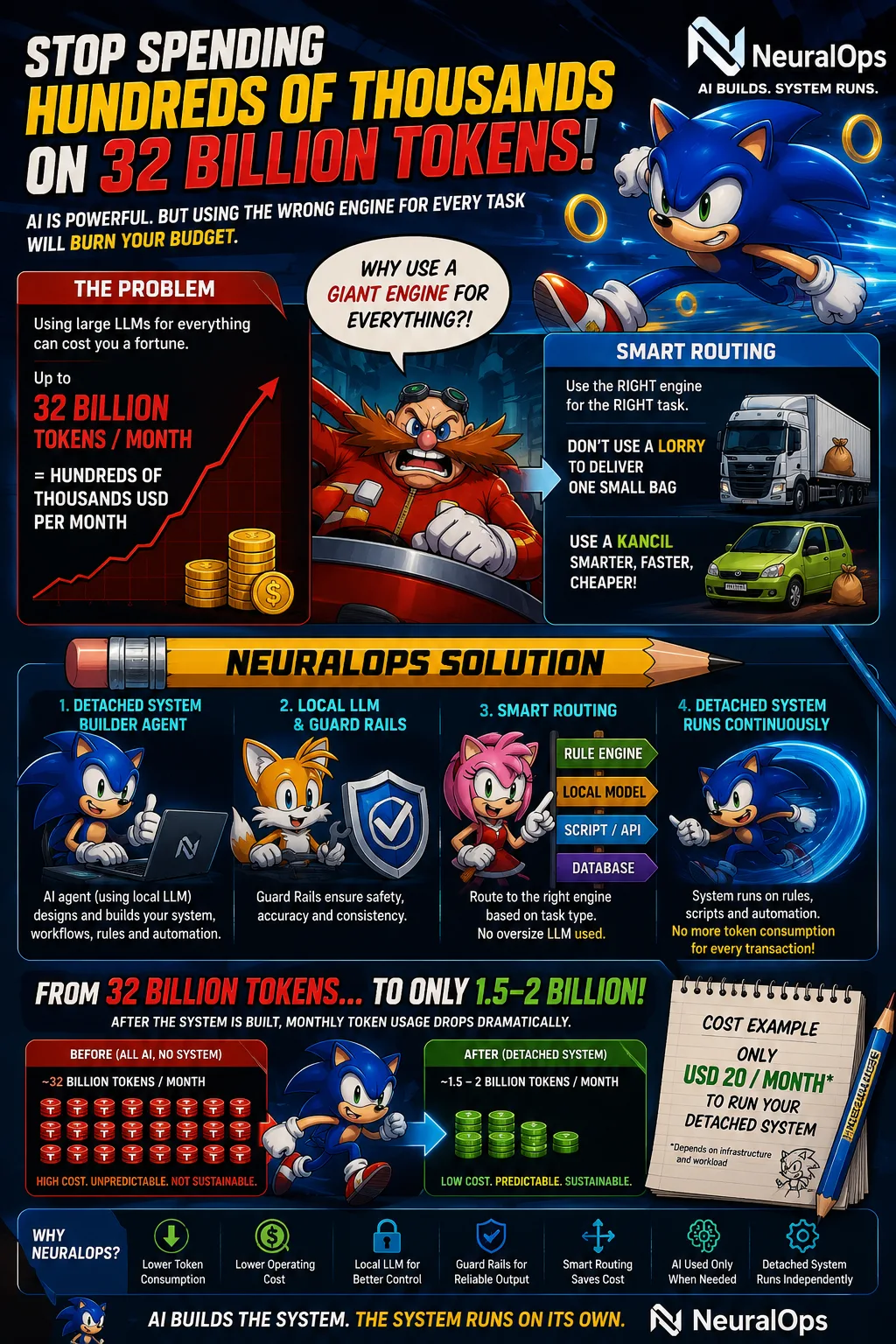
The second approach is different. AI does not read everything repeatedly. A detached 系统 first extracts the bank statement into structured transaction rows, cleans the data, detects duplicates, separates transfers, applies accounting rules, maps standard descriptions, validates the output, and only routes unclear or risky transactions to AI.
With this approach, Qwen or another lower-cost model can be used because the guardrails already control the workflow. The model is not asked to “understand everything from zero”. It only handles selected exceptions. If only 5% to 15% of transactions need AI review, total token usage may drop to around 3 million to 7 million 令牌 for all 100 中小企业.
Using a mid-range estimate of 5 million 令牌, split as 80% input and 20% output, that means 4 million input 令牌 and 1 million output 令牌. 采用 low-cost Qwen-style routed model, the AI inference cost could be below $1 in some pricing structures, excluding OCR, hosting, storage, engineering, and review cost.
So the real comparison is not simply Claude versus Qwen. That is too shallow. The real comparison is architecture. Claude processing everything directly may cost around $126 to $189 for this example. A detached 系统 using Qwen only for routed exceptions may reduce the AI token cost to below $1, depending on provider pricing.
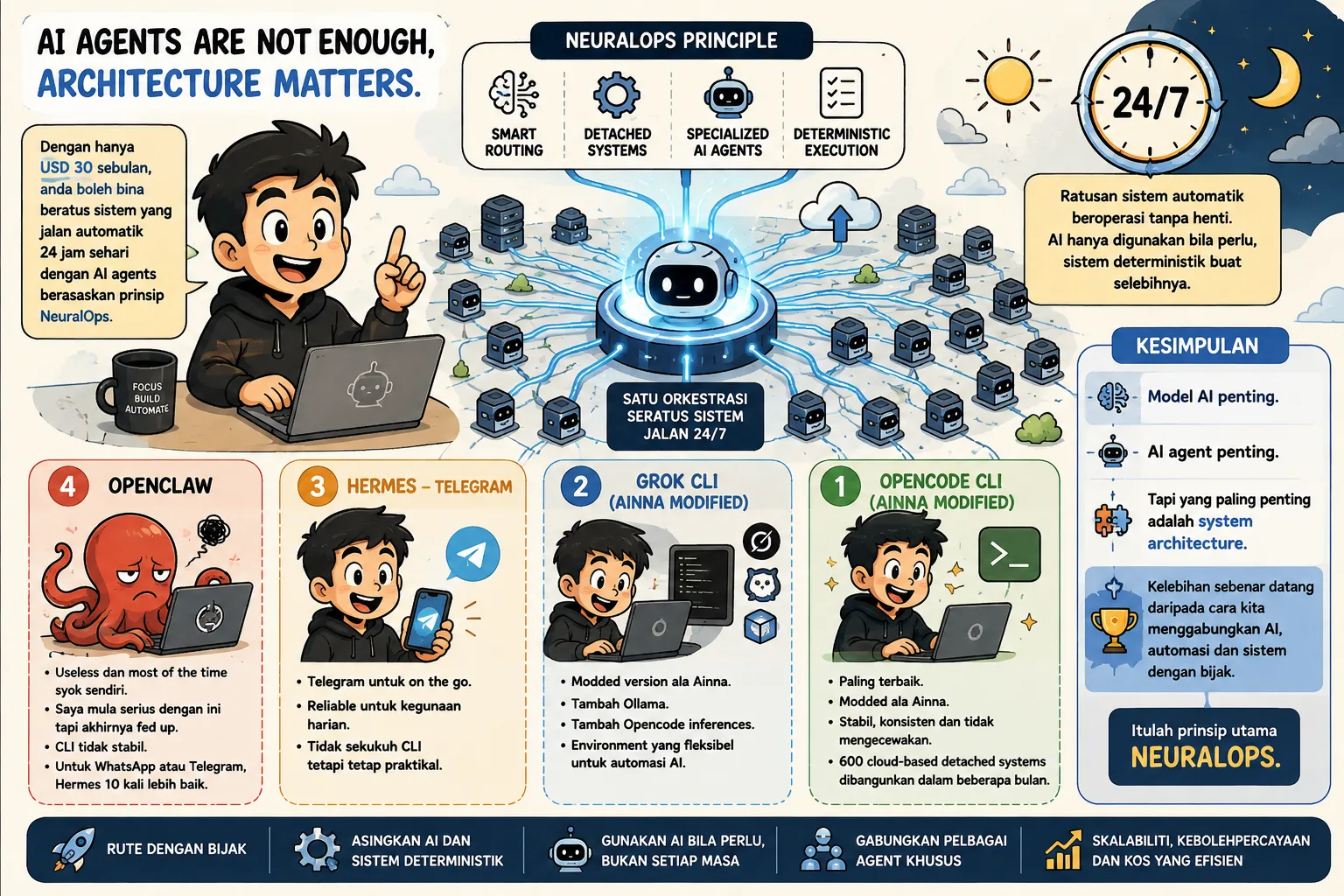
This is why 智能路由, segmentation, and guardrails matter. The future of 中小企业 financial statement automation is not “send 10,000 pages to the biggest AI model”. The smarter model is: 系统 handles what is structured, AI handles what is uncertain, and humans review what is risky.
That is where cost saving becomes serious.
#ArtificialIntelligence #AIAgents #DetachedSystems #SmartRouting #护栏 #会计 #中小企业 #FinancialStatements #TokenEfficiency #自动化 #ESG















Ruang pembaca
Apa pendapat anda?
Komen baharu dihantar untuk semakan terlebih dahulu. 名称 dan email diperlukan, tetapi email tidak dipaparkan kepada pembaca.
简单直接。100就能说明问题。
这篇文章适合团队用来开始讨论and 7 mil 20%。 值得再看一遍。
per 中小企业, including 500,000这个说法我要拿回去跟同事讨论。
文章把become. 想象 100 100和日常运营联系起来,这一点很有帮助。
同意作者对pages of financi 10,000的判断,但执行起来还有难度。 这点我还要再消化一下。
关于令牌 per 中小企业, 200,000的例子很实用,适合团队继续讨论。