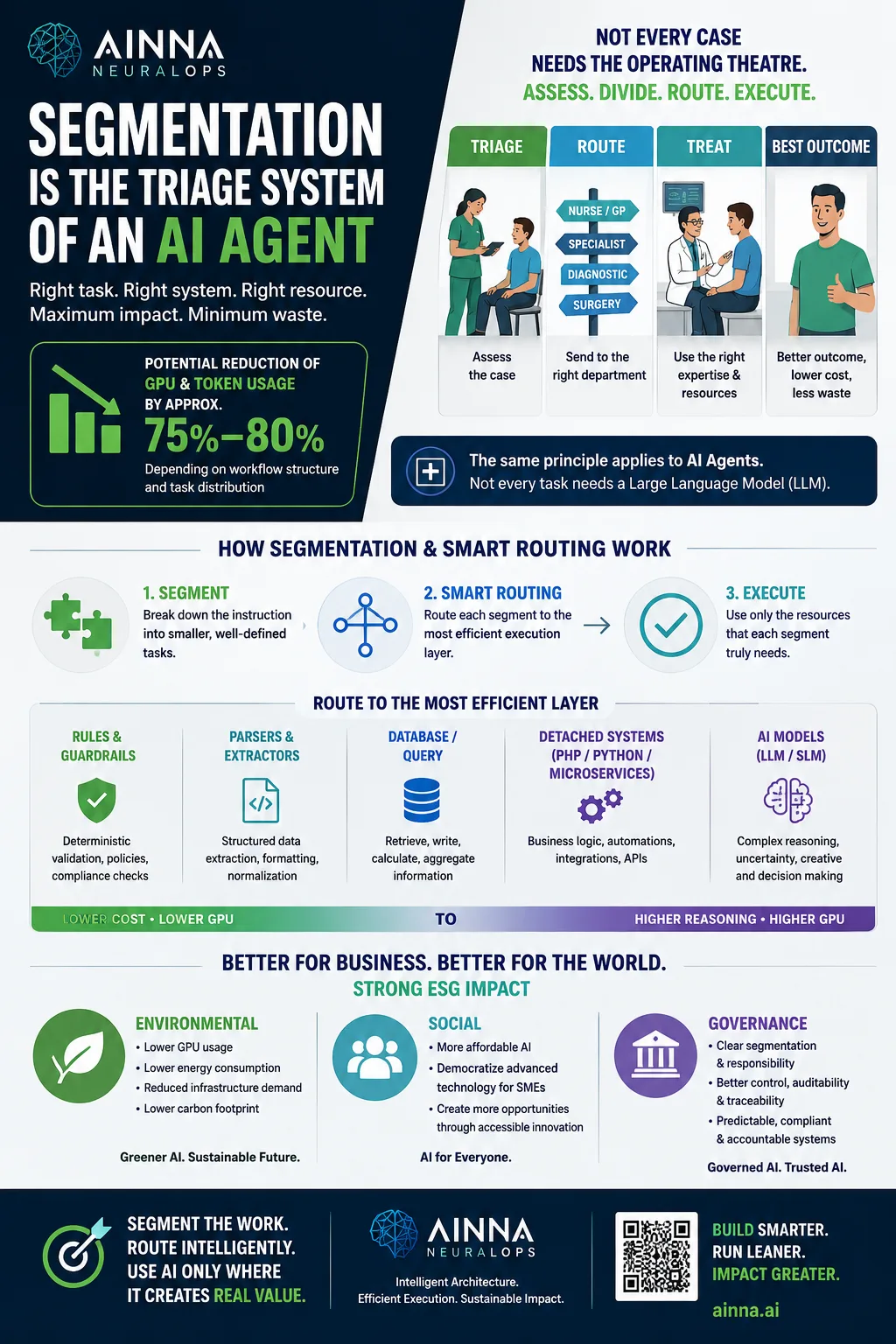
In production, the easy default is to pipe everything into the LLM. Every classification, summary, and workflow gets pushed through a large model, even though a rule engine, a cached lookup, an automation script, or a lightweight classifier could handle it faster and cheaper.
That is the gap AINNA NeuralOps is built to close.
NeuralOps isn't about fearing AI. It's about running AI with the right operational discipline. 智能路由 places each request on the right processing layer. 独立系统 absorb repetitive 工作流 without blocking the main pipeline. GPU-backed inference is escalated only when the task actually needs reasoning. 护栏 stop retry loops, token bloat, 失败 outputs, and wasted compute from multiplying.
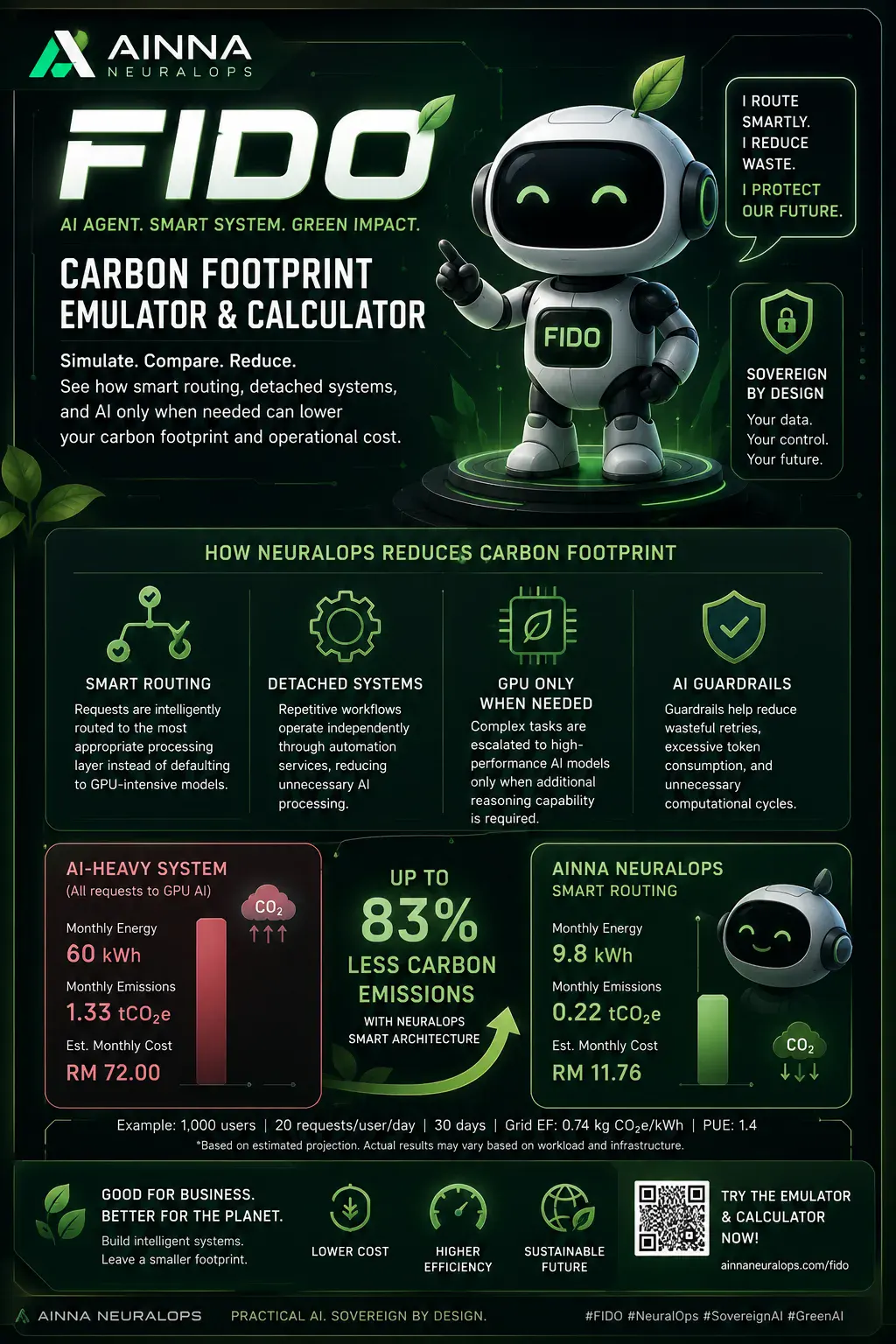
This is why we're building the AINNA NeuralOps 碳足迹 模拟器 & 计算器.
The idea is straightforward: simulate the carbon cost of different architectures side by side. 比较 a 系统 where 100% 的请求 hit GPU 密集型 AI against a NeuralOps 设计 where detached 系统, rule-based automation, CPU processing, and lightweight AI absorb most of the load, escalating only the complex cases.
This matters because AI infrastructure is no longer just a software problem. It's an energy problem. The 国际 能源 Agency projects global data centre electricity consumption could more than double to around 945 TWh by 2030, with AI as a major driver of that growth.
So instead of vague claims like "our AI is green", the better questions are:
Can we 测量 it? Can we compare it? Can we reduce it by 设计?
The calculator will estimate total requests, routing percentage, energy use in kWh, carbon footprint in kg CO₂e, estimated cost, and reduction percentage between AI-heavy processing and NeuralOps-optimized processing. It also exposes the assumptions clearly, because this is an estimation tool, not a certified carbon audit.
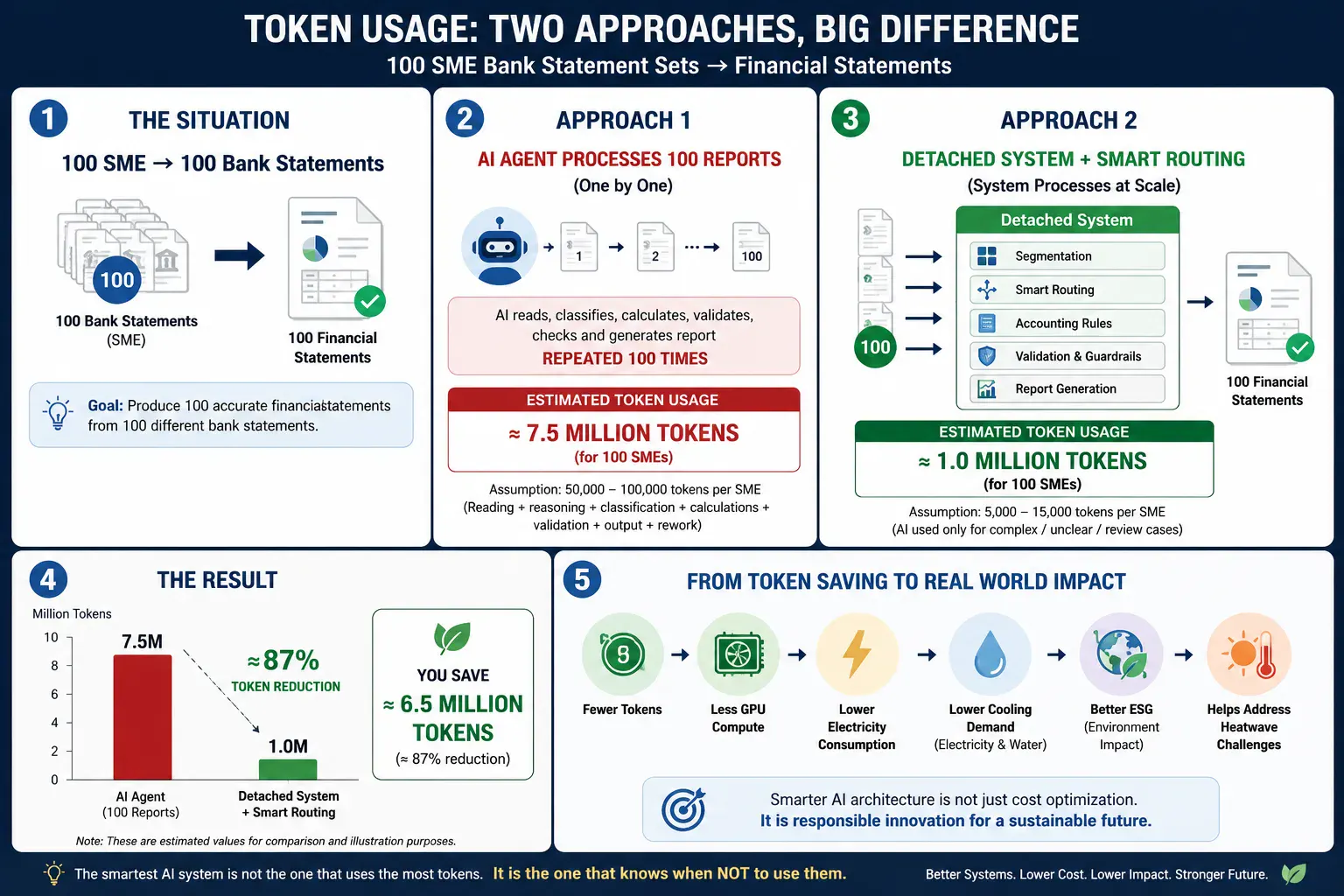
For 中小企业, this approach matters even more. They don't need expensive AI-heavy infrastructure for every routine workflow. 每日 processes - bank statement parsing, categorization, stock checking, report generation, and data cleaning - can be handled by detached 系统 first, with AI used only when needed.
That's the future we're engineering toward:
Practical AI. 主权 control. 更低 waste. Better operations.
AI shouldn't just be powerful.
It should be efficient, accountable, and designed with purpose.
AINNA NeuralOps - Practical AI, 主权 by 设计.
#Ainna #NeuralOps #SovereignAI #PracticalAI #CarbonFootprint #GreenAI #ResponsibleAI #AIInfrastructure #DetachedSystem #SmartRouting #SMEInnovation #ESG #SustainableAI
Official 跨-网络 Resource
















Ruang pembaca
Apa pendapat anda?
Komen baharu dihantar untuk semakan terlebih dahulu. 名称 dan email diperlukan, tetapi email tidak dipaparkan kepada pembaca.
文章对失败 outputs, and wasted compute的结论比较平衡,不只是强调好处。
我喜欢文章对carbon footprint in kg CO₂e保持务实的态度。
这篇文章对智能路由 places的解释很清楚,实际操作的重点也很容易理解。
关于every classification, summary, and workflow的例子很实用,适合团队继续讨论。 值得再看一遍。
我特别喜欢设计 where de 100%这一部分,内容没有把实施过程说得太简单。
我会把独立系统 absorb repetitive 工作流 without这一段分享给需要了解技术的同事。
看第二遍才注意到rule-based automation, CPU processing的细节。 这个部分我还需要再想一下。
我对计算器.The idea is straightforward: simulate还有问题,但文章已经提供了很好的起点。
这篇文章把比较 a 系统 where 100%讲得比一般的AI介绍更具体。
难得有人把escalating only the complex cases.This讲得这么直白。
如果有更多routing percentage, energy use的数据和结果会更完整。