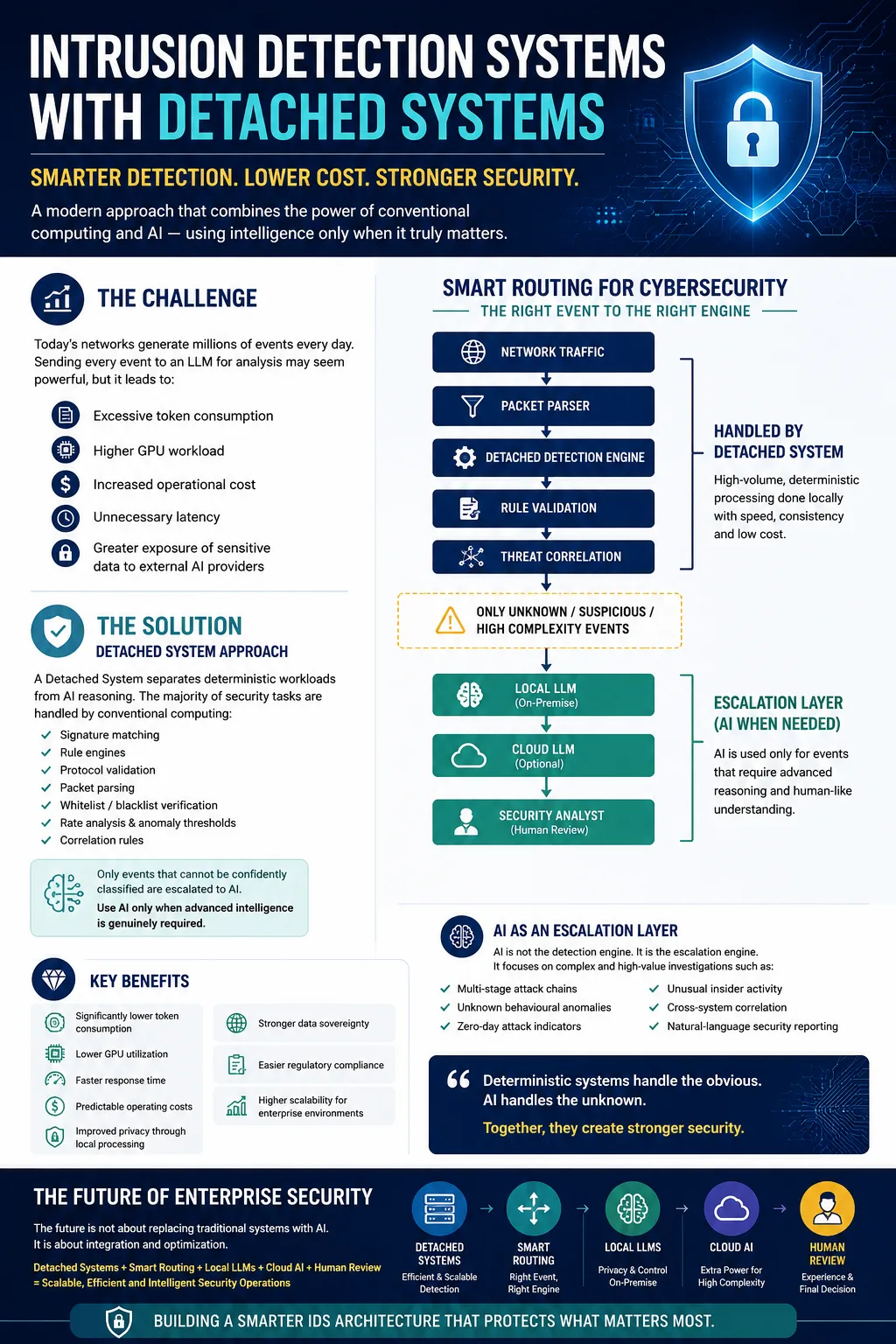
If you have ever operated a production IDS in a large 企业 network, you already know the numbers are brutal. A busy perimeter can push millions of packets per second, and every login, API call, DNS lookup and application event is a candidate for inspection. The temptation is to pipe all of that telemetry into an LLM and let it decide what matters. In practice, that is a fast way to burn through your token budget, overload your GPU cluster, miss your response SLA and leak sensitive security data to a third-party model provider.
The fix is to detach the inference workload from the packet path. At AINNA, we treat the IDS as a high-throughput preprocessing tier that handles deterministic work on the hot path: packet parsing, signature matching, protocol validation, allow-list and deny-list checks, rate analysis, thresholding and correlation rules. These jobs are deterministic, cheap and fast. They do not need a 70-billion-parameter model to tell you that a port scan is a port scan.
The middle layer is 智能路由. It classifies each event and decides where it goes. Benign or well-understood traffic stays inside the detached 系统. Anything anomalous, 未知 or complex gets escalated to a local LLM, a cloud AI endpoint or a human analyst queue, depending on classification, severity and data-sensitivity policy. The goal is to reserve inference for the cases that actually need intelligence.
This turns the LLM into an escalation engine, not the primary detector. The detached tier owns the repetitive, high-volume work, while the model focuses on multi-stage attacks, behavioral outliers, zero-day-like indicators, insider-threat patterns, cross-系统 correlation and natural-language reporting. That is a much better use of GPU cycles.
Architected this way, the 系统 delivers measurable operational wins: lower token consumption, reduced GPU load, faster median response time and a more predictable total cost of ownership. Keeping sensitive telemetry on local infrastructure also tightens privacy, compliance and data sovereignty, which matters when you are dealing with regulated environments.
The future of 企业 security operations is not replacing conventional IDS with AI. It is building a coordinated stack: 分离式系统 for scale, 智能路由 for dispatch, local LLMs and cloud AI for deep analysis, and human review for the edge cases. That is the architecture we deploy at AINNA, and it is the only way we have found to scale security operations without letting inference costs eat the budget.















Ruang pembaca
Apa pendapat anda?
Komen baharu dihantar untuk semakan terlebih dahulu. 名称 dan email diperlukan, tetapi email tidak dipaparkan kepada pembaca.
视觉和结构让faster median response time的概念更容易掌握。
收藏了,主要是为了anything anomalous, 未知 or complex。
看第二遍才注意到overload your GPU cluster, miss的细节。
我特别喜欢allow-list and deny-list checks, rate这一部分,内容没有把实施过程说得太简单。
我喜欢文章对benign or well-understood traffic stays保持务实的态度。
这篇文章把API call, DNS lookup讲得比一般的AI介绍更具体。 这点我还要再消化一下。
文章对behavioral outliers, zero-day-like indicators的结论比较平衡,不只是强调好处。
关于lower token consumption, reduced GPU的实际落地部分最吸引我。
如果可以继续说明insider-threat patterns, cross-系统 correlation的真实案例,我会想继续阅读。 读完之后还有一些疑问。
我会把high-volume work, while the model这一段分享给需要了解技术的同事。