At AINNA, we see a lot of enterprises building their AI roadmap on one assumption:
Pick the biggest LLM available, plug it into the data stack, and run every workflow through it.
That gets you through early pilots.
It does not survive production scale.
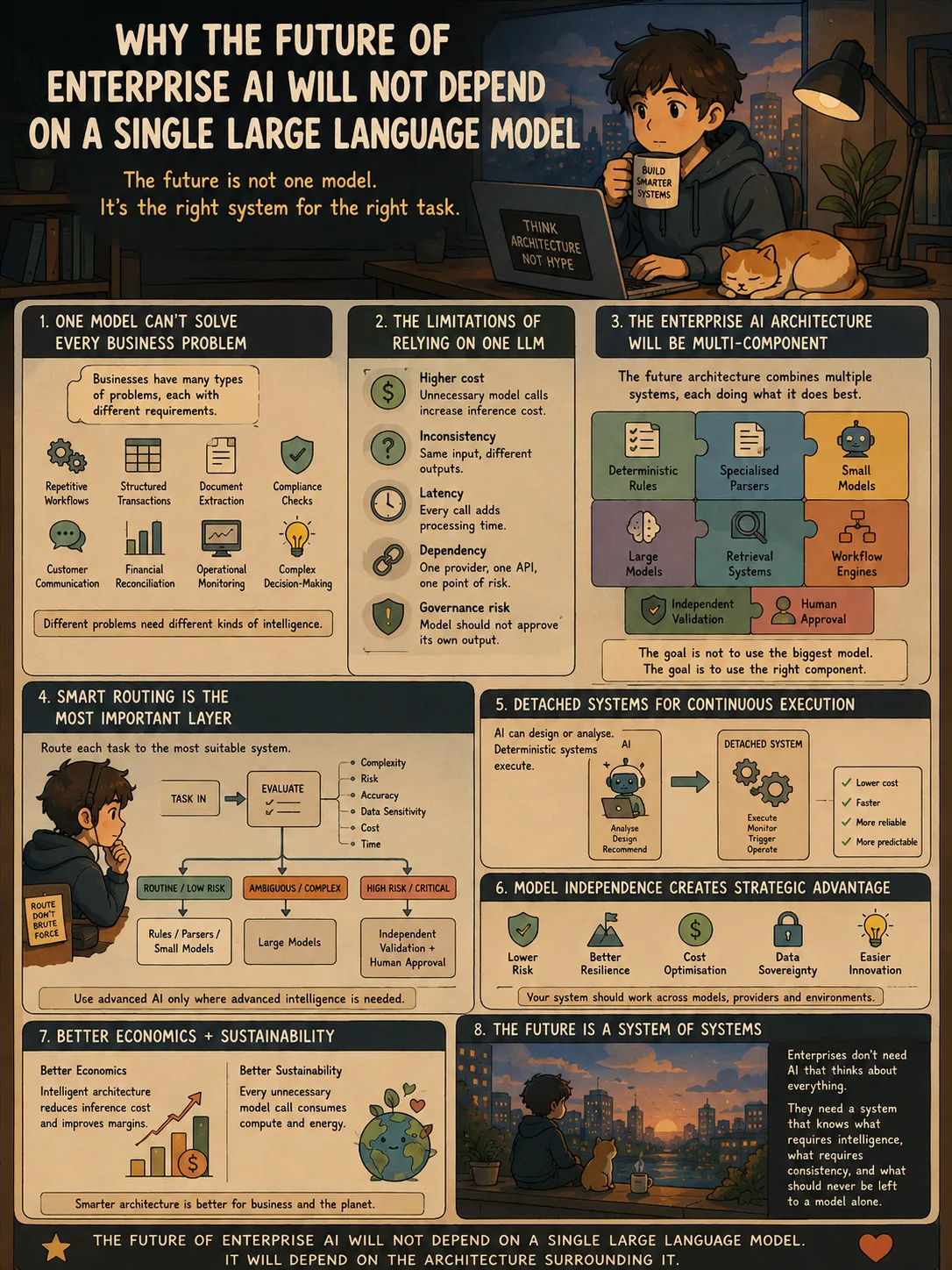
A real 企业 is not one problem type.
It runs:
repetitive operational 工作流
structured transactions
document extraction
compliance checks
customer communication
financial reconciliation
operational monitoring
complex decision-making
Each workload has different requirements.
Some need deep reasoning. Others need speed, consistency, privacy, deterministic accuracy, or rock-bottom unit cost.
Many do not need an LLM at all.
Sending a large model a date-format check, a balance lookup, or a known-field extraction is wasteful. It drives up latency, token cost, and dependency without returning proportional value.
The more durable 企业 architecture is a coordinated stack:
deterministic business rules
specialised parsers
小 语言 Models (SLMs)
大 语言 Models (LLMs)
retrieval 系统
workflow engines
independent 验证层
human approval gates
The layer that matters most is 智能路由.
Before a task hits any model, the orchestrator should classify it by complexity, risk, required accuracy, data sensitivity, and cost ceiling.
常规 work goes to lightweight, deterministic components.
Ambiguous or high-stakes work gets escalated to the right LLM.
高-risk outputs should 通过 through independent validators before anything executes.
That brings us to a second operating principle:
AI governance must sit outside the model.
A model should not generate, validate, and approve its own output without external controls.
生产 系统 need schema enforcement, reconciliation, RBAC, audit logs, transaction limits, and automatic escalation paths.
We also see a clear role for 分离式系统.
An LLM can 设计, analyse, or modify a workflow, while deterministic software executes that workflow continuously without calling the model on every 通过.
This pattern cuts inference cost, improves reliability, and makes automation auditable.
So the future of 企业 AI is not one universal model controlling every process.
It is a 系统 of 系统, orchestrated.
LLMs will stay central, but they will be one component inside a broader architecture of routing, validation, specialised processing, and independent execution.
The long-term winners may not be the companies using the most AI.
They will be the ones that deploy advanced AI only where advanced intelligence is genuinely required.
#EnterpriseAI #AIInfrastructure #ArtificialIntelligence #LLM #AIAgents #自动化 #DigitalTransformation #SovereignAI #SmartRouting #TechStrategy
















Ruang pembaca
Apa pendapat anda?
Komen baharu dihantar untuk semakan terlebih dahulu. 名称 dan email diperlukan, tetapi email tidak dipaparkan kepada pembaca.
如果可以继续说明high-stakes的真实案例,我会想继续阅读。
关于orchestrated.LLMs will stay central的例子很实用,适合团队继续讨论。
文章对deterministic components.Ambiguous的结论比较平衡,不只是强调好处。 读完之后还有一些疑问。
同意作者对known-field的判断,但执行起来还有难度。
improves reliability, and makes automation这个说法我要拿回去跟同事讨论。
这篇内容让我更容易理解为什么validation, specialised processing值得关注。
文章把date-format和日常运营联系起来,这一点很有帮助。
如果有更多analyse, or modify a workflow的数据和结果会更完整。
关于consistency, privacy, deterministic accuracy的实际落地部分最吸引我。
这篇文章对rock-bottom的解释很清楚,实际操作的重点也很容易理解。 值得再看一遍。
还在消化这部分这一段。
先存起来,主要是为了这段说明。
看第二遍才注意到validate, and approve its own的细节。 读完之后还有一些疑问。
这篇文章适合团队用来开始讨论risk, required accuracy, data sensitivity。