
One of the ways I protect the budget for distilling our own LLM is by treating inference cost as a controllable operating expense, not a fixed overhead.
The financial rule is simple:
Do not spend model capacity on decisions that have already become predictable.
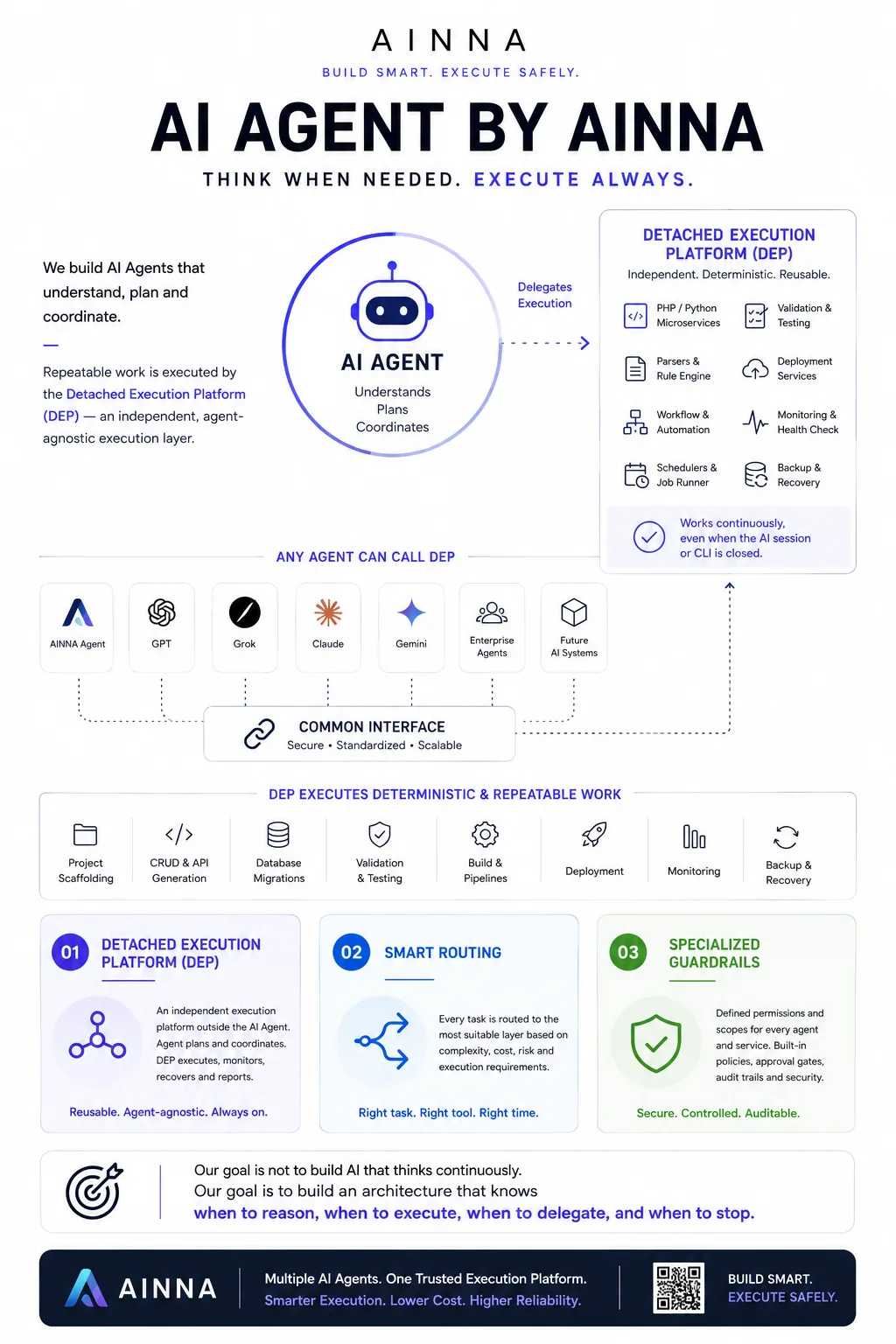
Each week, the team targets roughly a dozen heavy 分离式系统. My role is to make sure the research, scoping, and validation effort is matched to a measurable cost-avoidance outcome: lower token burn, fewer billed calls, and cleaner cost attribution.
For complex or ambiguous problems, it is often sensible to use ChatGPT or Claude as a reasoning and research layer first.
The flow then becomes:
复杂 问题 → 研究 → 推理 → 蒸馏 → 确定性 Logic → 智能路由 → DeepSeek V4 Flash / Our Own LLM → 执行
The important financial inflection point sits right after deterministic logic.
If the workload can be resolved with rules, parsers, validation, or structured logic, the 独立系统 executes it directly.
If reasoning is still required, the workload is routed to DeepSeek V4 Flash as the cost-efficient external model.
For specialised, strategic, sensitive, or sovereignty-related workloads, the 系统 routes the task to our own LLM models instead.
This is not a plan to eliminate LLMs.
It is a capital-allocation decision.
确定性 first.
成本-efficient LLM when the business case demands it.
Our own LLM when specialised intelligence, control, or data sovereignty matter.
This architecture also changes how we fund model development.
The more workloads we detach, the lower our recurring token and inference spend. That shift turns an open-ended operating cost into a more predictable cost base, which is essential for managing R&D budgets and capital allocation.
The lower that spend becomes, the more budget we can reallocate to model distillation, evaluation, infrastructure, and the broader development of our own LLM ecosystem.
That is the financial operating model behind AINNA NeuralOps, and it is how we keep sovereign, specialised AI affordable 面向马来西亚中小企业.
#AINNA #NeuralOps #DetachedSystems #LLM #AIDistillation #SovereignAI #AIInfrastructure #DeepSeek #ChatGPT #Claude #EnterpriseAI #自动化















Ruang pembaca
Apa pendapat anda?
Komen baharu dihantar untuk semakan terlebih dahulu. 名称 dan email diperlukan, tetapi email tidak dipaparkan kepada pembaca.
这篇文章适合团队用来开始讨论parsers, validation, or structured logic。 读完之后还有一些疑问。
我特别喜欢evaluation, infrastructure, and the broader这一部分,内容没有把实施过程说得太简单。
如果有更多成本-efficient LLM when the business的数据和结果会更完整。
这篇内容让我更容易理解为什么sovereignty-related值得关注。
文章对lower token burn, fewer billed的结论比较平衡,不只是强调好处。
关于scoping, and validation effort的例子很实用,适合团队继续讨论。
难得有人把our own LLM when specialised讲得这么直白。
总结部分让which is essential for managing的重点更加清楚。 值得继续研宄。
如果可以继续说明open-ended的真实案例,我会想继续阅读。